
Vanishing Tribes Photo Tour - full itinerary
Our Northeast India presents extraordinary opportunities to document rapidly disappearing tribal cultures across Arunachal Pradesh, Assam, and Nagaland. From the terraced valleys of Ziro to the remote villages along the Myanmar border, this journey captures ancient traditions maintained for centuries yet vanishing within a generation.
In Arunachal Pradesh's Ziro Valley, elderly Apatani women still wear facial tattoos and nose plugs, practices banned since the 1970s. Their sustainable farming methods and animistic beliefs provide intimate glimpses into a harmonious relationship between people and land, preserved through pine-clad hills and emerald rice terraces.
Majuli Island offers rich photographic subjects through its Vaishnavite monasteries, traditional mask-making workshops, and Mishing tribal villages. The interplay of ancient religious practices and indigenous tribal life creates compelling narratives along the Brahmaputra's banks, where pottery and weaving continue unchanged for generations.
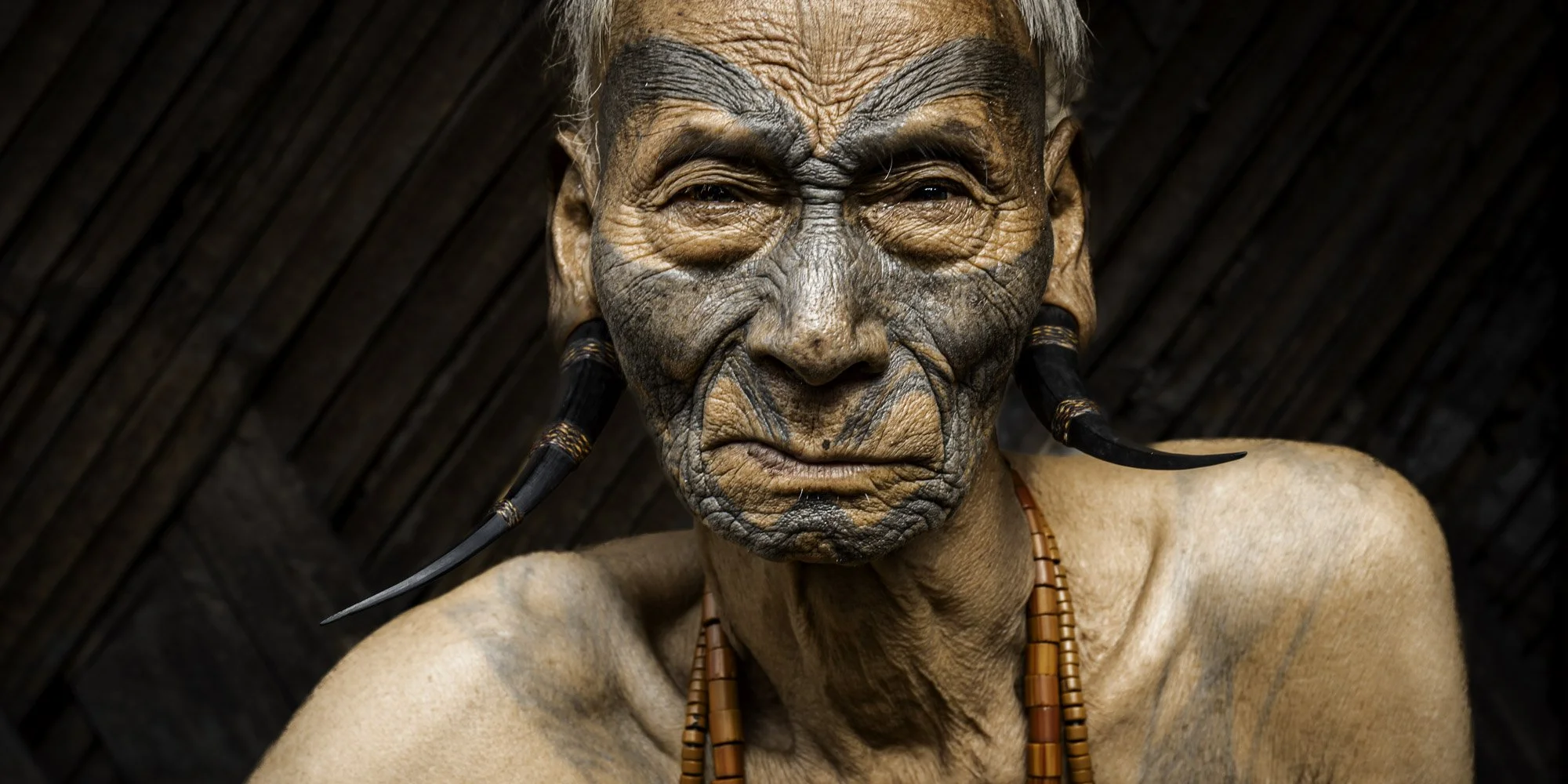
Nagaland's Konyak villages showcase the last surviving tattooed headhunters, their facial markings telling stories of warrior pasts now fading into memory. Traditional morungs adorned with animal skulls, brass ornaments and ceremonial architecture document cultures balanced between ancient traditions and inevitable modernisation.
Day 1:
Arrive Kolkata
We will arrange for you to be picked up from the airport and taken to our boutique hotel in the city. Nathan runs an optional pre-tour technical workshop from around 3-5pm for those new to travel photography or who feel they would benefit from a refresher course (please confirm your interest). There’s a meet ‘n’ greet with Nathan at the hotel starting at around 6pm, followed by drinks and dinner with the group.
Day 2:
Kolkata
Today we enjoy sunrise at the iconic Howrah Bridge and Hooghly River ghats, and capturing the atmospheric morning rituals, silhouettes and vibrant scenes at the nearby flower market. We return to our hotel for breakfast, after which we head to Kumartuli, the traditional potters' quarter of the city, where skilled artisans have crafted clay idols for generations. Working in atmospheric workshops open to the street, they offer wonderful opportunities for intimate portraits and detail shots in beautifully dramatic, naturally occurring light.
We return to our hotel for lunch and a rest then, later in the afternoon, we head to College Street for some candid street photography. The area is a paradise for book lovers and photographers alike, with its legendary rows of second-hand booksellers lining the pavements and spilling into narrow lanes. The fascinating interplay of scholars, students, and traders among towering stacks of books, combined with the grand facades of the nearby Presidency University and Calcutta University, makes for rich street photography full of character and intellectual atmosphere.
We end the day with sunset at the famous Kalighat temple — built around 200 years ago as an abode for the Hindu Goddess Kali — where we witness the atmospheric daily Pooja. Devotees bearing flower offerings, the scent of incense, and the sound of bells ringing create a powerful and memorable sensory experience.
Day 3:
Kolkata — Itanagar
After breakfast, we visit the area around N.S Road, a major commercial thoroughfare in central Kolkata located in the BBD Bagh area near the Hooghly River that’s ideally suited to street photography The dense mix of traders, hawkers, porters, and commuters creates constant movement and layered compositions. Hand-pulled rickshaws, which are increasingly rare elsewhere, still operate here and make for iconic Kolkata imagery. The street is lined with grand colonial-era buildings, many in various states of elegant decay, offering striking facades, ornate balconies, and peeling shutters that reward detail shots as much as wide-angle streetscapes.
We then return to our hotel, check out and head to the airport for our 2pm departure to Itanagar, the capital of the northeast Indian state of Arunachal Pradesh. On arrival, we will be collected from the airport then we check in at our hotel.
After lunch, we pay a visit to a Buddhist Gompa, a serene and spiritually significant monastery that stands as a testament to the rich Buddhist heritage of the region. We admire the intricate architecture, colourful murals and sacred relics that make this place a peaceful retreat for meditation and reflection.
Later in the afternoon, we visit the vibrant local market in Itanagar, where the culture and daily life of the locals come alive. The market buzzes with activity, offering a mix of traditional handicrafts, tribal textiles, bamboo products, and locally produced spices. We can interact with the local vendors to get a deeper understanding of their crafts and livelihoods.
Day 4:
Itanagar — Ziro
Today after breakfast we visit a tribal market to capture shots of local culture and daily life. From there we set off on the 4-5 hour drive to the picturesque town of Ziro, which is inhabited mainly by the Apatani people. The area is renowned for its terraced paddy fields where the unique system of poly-culture and water management is practiced by the local people.
Ziro is almost a level valley enclosed on all sides by pine-clad low-stooping hills. The area, also known as the Apatani Plateau, is famous for Paddy-cum-Fish culture. Here we discover the local culture of the Apatani tribe, whose old ladies still practice the unique tradition of nose plugs piercing and facial tattooing. The tribe practices Doniy Polo animism and believes in Sun and Moon.
We arrive in Ziro in the late afternoon, just in time to visit a blacksmith and find a sunset spot. Afterwards, we check in to our hotel and enjoy dinner with the group.
Day 5:
Ziro
Early this morning, we make our way to the Old Ziro viewpoint, where a breathtaking panoramic vista of the magnificent Ziro valley unfolds before us — a sweeping patchwork of pine-covered hills, terraced paddy fields, and traditional village settlements that rewards wide-angle landscape photography as much as quiet contemplation. The soft early morning light lends the valley a particularly ethereal quality, with mist sometimes lingering in the lower reaches and adding an atmospheric depth to the scene.
Afterwards, we set off for a full day of immersive exploration among the Apatani tribe, one of northeast India's most distinctive and fascinating indigenous communities. We are welcomed into the homes of village elders, where the elderly women — bearing the tribe's remarkable traditional nose plugs and intricate facial tattoos that were once marks of beauty and identity — offer some of the most extraordinary and moving portrait opportunities of the entire tour.
After a relaxed lunch, we venture deeper into the interior of the valley to visit Hong, the largest and most impressive of the Apatani villages, where the scale and vitality of community life make for rich and varied street photography. We continue on to the smaller villages of Bulla, Hari, and Hija, each with its own distinct character and charm, offering candid scenes of weaving, farming, and daily domestic life at every turn.
We round off this remarkable day with a walk through a serene bamboo forest before climbing to a favourite sunset spot, where the valley below is bathed in warm golden light and the hills fade gently into the dusk
Day 6:
Ziro — Majuli (5-6 hour drive)
This morning, after breakfast, we drive past paddy fields to see villagers at work (step farming). We continue onwards to Majuli, famously known as the world's largest (or, arguably, second largest) river island. It is formed by the Brahmaputra River to the south and east, the Subansiri River to the west, and a branch of the Brahmaputra River called Kherkutia Xuti to the north.
Majuli is the cultural capital of the state of Assam. Shrimant Sankardeva established this practice of Vaishnavism in the 16th century. Vaishnavism is a sect of Hinduism where they worship Lord Vishnu, The Protector, and his re-incarnation. The major population of this island is made up of the Mishing tribe, who are believed to have migrated from present Arunachal Pradesh.
En route to the island, we stop at the Assam Tea Gardens to see the tea workers. If time permits, we make stopovers on roadside paddy fields and villages as any photo opportunities present themselves. On arrival in Majuli Island we settle down in our guest house for our overnight stay.
Day 7:
Majuli
At sunrise, we take an atmospheric walk along a tranquil riverbank dotted with elegant bridges and traditional Chinese fishing nets, their graceful wooden frames silhouetted against the early morning light reflecting off the water. The gentle pace of the walk allows time to absorb the unique character of Majuli — the world's largest river island — and to capture the kind of quiet, unhurried moments that define life on this remarkable and culturally extraordinary place.
We spend the rest of the morning exploring Majuli's the ancient Vaishnavite temples, known as satras, where robed monks perform traditional rituals that have remained largely unchanged for centuries. The interplay of candlelight, incense smoke, and devotional chanting creates an atmosphere of spiritual intensity, while the temple architecture and surrounding gardens offer an equally rewarding range of compositional possibilities. The Chamaguri Satra is a particular highlight, renowned for its extraordinarily skilled mask-making artisans, whose intricately crafted ceremonial masks — used in traditional Sattriya dance performances — make for fascinating detail shots and compelling portraits.
After lunch, we visit the villages of the Mishing tribal community, where daily life unfolds at a gentle and photogenic pace along the banks of the Brahmaputra. Traditional stilt houses rise above the floodplain, while women sit at hand looms weaving colourful textiles in domestic scenes of quiet beauty and cultural richness.
Towards sunset, we make our way to a local car ferry port, where all manner of wooden boats pull up for the night, their reflections shimmering in the fading golden light and bringing the day to a wonderfully atmospheric close.
Day 8:
Majuli — Mon Village (5-6 hour drive)
We set off early this morning to drive to Mon Village in Nagaland, beginning what promises to be one of the most culturally rich and visually rewarding days of the entire tour. We start our journey with an atmospheric river cruise of around one and a half hours, gliding through the lush landscape to reach the head of the road that connects to Mon Village.
Along the way, we pause to visit a number of significant historical Ahom monuments, including the towering Shiva Dol temple in Sivasagar — its distinctive beehive-shaped shikhara rising dramatically against the sky — and the remarkable seven-story Kareng Ghar palace, whose imposing scale and intricate detailing offer a vivid showcase of the dynasty's extraordinary architectural grandeur and enduring legacy.
Mon Village is home to the Konyak Nagas, once feared headhunters whose formidable reputation has given way to a warm welcome for visitors eager to witness their deeply distinct and fascinating culture. Traditional face tattoos, worn as marks of status and bravery, and elaborately ornate headdresses make the Konyak elders among the most striking and photographically compelling subjects anywhere in northeast India.
The Konyak people are equally renowned for their exceptional craftsmanship, producing richly detailed woodcarvings, ceremonial headgears, and intricate necklaces and ornaments that reflect generations of artistic tradition and cultural pride.
Upon arrival in Mon Village, we make a brief visit to the police station for the necessary foreigners' registration formalities before checking into our characterful tented retreat, which offers a wonderfully immersive base from which to explore this remarkable corner of Nagaland.
Day 9:
Mon Village — Hongphoi — Mon Village
After breakfast, we drive to Hongphoi Village, another fascinating Konyak settlement, featuring a traditional morung (community hall) richly adorned with ancient wood carvings and animal skulls that speak powerfully of the tribe's warrior heritage. The main attractions of the village are the elaborately colourful traditional attire worn by its inhabitants and the deeply rhythmic beating of log drums within the morung, creating an immersive cultural experience that is as rewarding to photograph as it is to witness.
The village's centrepiece is the local king's house, impressively decorated with ceremonial wooden pillars and relics from headhunting days that offer extraordinary detail shots and historical insight in equal measure. Here, Konyak elders gather to share vivid stories of their warrior past, their weathered faces and traditional brass ornaments making for some of the most compelling and intimate portrait opportunities of the entire tour.
In the afternoon, we visit another nearby Konyak settlement to explore the rhythms of everyday village life at a more leisurely pace, photographing domestic scenes, local crafts, and candid moments of community life. As the light fades, we make our way back to our characterful tented retreat in Mon Village, where the sounds of the Nagaland hills provide a memorable and atmospheric end to the day.
Day 10:
Mon Village — Longwa — Mon Village
Straddling the India-Myanmar border, Longwa is a remarkable Naga village whose chief's house famously sits in two countries simultaneously. The village elders, many bearing traditional facial tattoos that speak of a proud headhunting heritage, offer extraordinary portrait opportunities. Wooden longhouses, colourful festivals, and the dramatic highland landscape of Nagaland combine to make this one of the subcontinent's most intriguing and photogenic destinations.
Today, we explore the village to meet and interact with the Angh, the hereditary chief who oversees 16 villages in Myanmar and four villages in Indian territory under his sovereignty. The house of the Angh of Longwa is situated half in India and half in Myanmar. We also meet some of the last surviving headhunters in the village. We return to our retreat in Mon Village for the night.
Day 11:
Mon Village — Dibrugarh
After an early breakfast, we drive down to Dibrugarh, a charming town in upper Assam set amid some of the world's most extensive and sprawling tea gardens. En route, we stop to visit a working tea factory, where we gain a fascinating insight into the journey from freshly plucked leaf to finished cup, with the processing machinery and neatly arranged drying trays offering compelling industrial photography opportunities.
On arrival, we take some time to rest and refresh before heading out to the banks of the mighty Brahmaputra for sunset. Here, the vast river — one of the great waterways of Asia — comes alive with atmospheric riverscapes, fishing boats returning with their catch, and candid scenes of local life unfolding along the water's edge in the warm evening light. We then return to our upscale hotel, whose sweeping views of the outer Himalayan foothills and the broad, glittering expanse of the Brahmaputra provide a magnificent and fitting end to the day.
Day 12:
Dibrugarh — Kolkata
This morning, we visit one of the many misty morning tea gardens. After breakfast, we visit Graham Bazaar, a vibrant local marketplace bustling with activity, where we can capture authentic scenes of daily life as shopkeepers and sellers interact with their customers. If time allows, we revisit the riverside where small cottage industries make clay pots by hand.
In the afternoon, we check out from our hotel and head to the airport for our departure to Kolkata. After checking in to our hotel, we visit Park Street, one of Kolkata's most vibrant and photogenic thoroughfares, where grand colonial architecture, neon-lit restaurants, and bustling pavement life create a compelling mix of old and new. The famous South Park Street Cemetery, with its crumbling Gothic and neoclassical tombs half-swallowed by vegetation, is a particularly atmospheric and rewarding spot for photographers.
In the evening, we enjoy a farewell dinner with the group in a classic Calcutta restaurant.
Day 13:
Departure from Kolkata
You have the day free at your leisure until our driver transfers you to the airport for your flight back home. We hope you will have had an enjoyable and memorable experience, and we look forward to seeing you again on another photographic adventure!